
Shipping goods from China to the Philippines may seem straightforward, but the process involves more than getting your cargo from one port to another. Transportation, paperwork, customs clearance, and delivery all need to be coordinated properly to keep your shipment moving.
That’s where a freight forwarder from China to the Philippines can make the process much easier. A reliable provider can coordinate shipping, customs clearance, documentation, and delivery while helping you manage costs, avoid delays, and keep your shipment on track.
Key Takeaways: How Do You Choose a Freight Forwarder From China to the Philippines?
- Choose a provider familiar with China-to-Philippines shipments and the requirements involved.
- Compare shipping methods such as sea freight, air freight, FCL, and LCL based on your cargo and timeline.
- Request a detailed quotation so you understand the full cost and potential additional fees, including charges based on the actual weight of your cargo.
- Check customs support and make sure the provider can guide you through the required documentation.
- Prioritize communication and tracking so you can stay updated throughout the shipment.
- Make sure the forwarder can handle your cargo, especially if you are importing machinery, oversized goods, fragile items, or high-value products.
- Check reviews and reputation, and confirm the forwarder has a physical office you can visit, before making your final decision.
- Compare overall value, not just price, when selecting a long-term logistics partner.
Table of Contents
- What Does a Freight Forwarder Do?
- Factors to Consider When Choosing a Freight Forwarder from China to the Philippines
- How to Compare Freight Forwarders
- Should You Choose a Freight Forwarder Based on Price?
- Choosing the Right Freight Forwarding Partner
- Frequently Asked Questions About China to Philippines Shipping
What Does a Freight Forwarder Do?
A freight forwarder helps coordinate the different steps involved in moving goods from your supplier in China to their final destination in the Philippines. Instead of dealing separately with shipping companies, customs, ports, and other logistics providers, you can work with one company to manage key parts of the process.
Depending on the service you choose, a freight forwarder may handle or coordinate:
- Booking cargo space with shipping or air freight carriers
- Arranging pickup from your supplier in China
- Preparing and checking shipping documents
- Coordinating international transportation
- Assisting with customs clearance
- Managing port or terminal requirements
- Providing shipment tracking and updates
- Arranging delivery to your destination in the Philippines
- Advising you on shipping requirements and potential costs
For businesses that regularly import from China, this support can save time and reduce the hassle of managing international shipments on their own. A freight forwarder can also help keep the different stages of the shipment coordinated, from pickup in China to delivery in the Philippines.
Factors to Consider When Choosing a Freight Forwarder from China to the Philippines
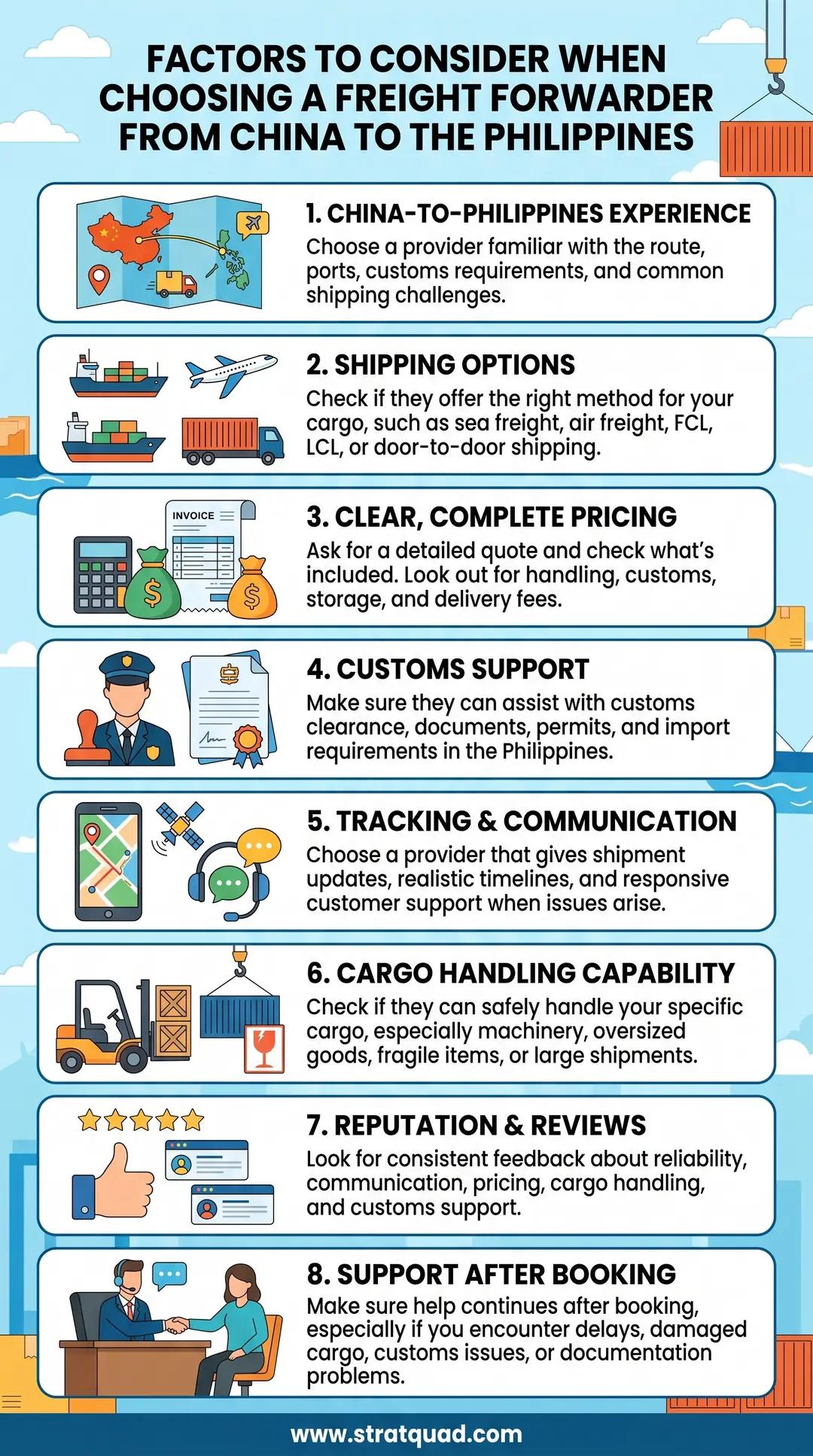
Not all freight forwarders offer the same services, rates, or level of support. Before choosing a provider, look beyond the initial quote and consider how well they can handle your shipment from pickup in China to delivery in the Philippines.
Experience With China-to-Philippines Shipping
Choosing a provider familiar with the China-to-Philippines route can make international shipping easier to manage. Familiarity with local logistics, documentation, ports, and common shipping challenges can help prevent avoidable delays and complications.
When comparing potential providers, ask how long they have handled shipments from China, which Chinese locations or ports they serve, and what types of cargo they typically manage. Check if they can also assist with customs clearance in the Philippines.
The right provider should be able to explain your available shipping options based on your cargo and destination. For example, shipping arrangements may vary depending on the supplier’s location, available transport options, and the specific requirements of your shipment.
If you are still looking for the right supplier, some forwarders also offer sourcing support, so supplier checks and shipping can be planned together.
Available Shipping Methods
Shipping method selection depends on your cargo's size, weight, value, destination, and delivery timeframe. Your freight forwarder should be able to recommend an option based on your actual requirements.
For China to Philippines shipping, sea freight is commonly considered for larger or heavier shipments, particularly when delivery speed is less urgent. Air freight, on the other hand, may be more suitable for smaller or time-sensitive cargo.
Related: Importing from China to the Philippines: The Complete Process
Depending on the provider, you may also have options such as:
- Full container load (FCL)
- Less than container load (LCL)
- Door-to-door shipping
- Port-to-port shipping
- Consolidated shipments
Smaller importers can usually start with LCL, since they share container space with other shipments and pay only for the space their cargo uses. As your volume grows, a full container can become more economical. For a 40-foot container, that point is often around 45 CBM, and FCL pays off most when your cargo is compact and dense enough to fill the container well, around 50 CBM of usable space in practice. Bulky, lightweight items take up space quickly and are often cheaper to ship LCL.
If you buy from more than one supplier, ask how the forwarder consolidates your goods. Some can only combine goods into one shipment when they arrive at the same China warehouse on the same day, so coordinate delivery dates with your suppliers before they ship.
Rather than choosing a service based solely on speed or price, ask the freight forwarder to explain which option makes sense for your shipment and why.
Transparent and Complete Pricing
Cost is an important part of choosing a freight forwarder, but the lowest initial quote may not always result in the lowest overall cost. Request a detailed quotation and clarify what is included. Depending on your shipment, charges may cover transportation, handling, documentation, customs-related services, storage, and final delivery.
One useful question to ask is: “What will I pay from pickup in China until the shipment reaches my final destination in the Philippines?” This can help you identify charges that may not be included in a basic freight rate. If a quote is significantly lower than others, ask the provider to explain what is covered and if additional fees could apply.
Some providers quote an all-in rate that already covers freight, customs clearance, and duties and taxes, while others quote each of these separately. Ask which approach a provider uses, since it changes what you are comparing. To get a starting figure before you request quotes, you can estimate your shipping cost based on your cargo's size and weight.
Also ask how weight is charged. Sea freight is usually priced by volume (CBM), but dense cargo can be charged by actual weight instead. For example, some forwarders treat any shipment at 500 kg per CBM or more as overweight and bill it by actual weight. The weight used is the one recorded when your goods arrive at the forwarder’s China warehouse, so expect the final figure to be based on actual measurements rather than your estimate.
“The most common surprise we see is overweight charges. Importers often plan based only on the volume of their cargo, but the final charge is based on the actual weight recorded when the goods reach the China warehouse. Dense or heavy items can trigger fees that were not in the original estimate.”
Charles Ryan Sy, CEO, StratQuad
Customs Clearance Support
Customs clearance is an important part of importing goods into the Philippines. Shipments may require documents such as commercial invoices, packing lists, bills of lading or air waybills, certificates of origin, and import permits or clearances, depending on the type of goods. The Bureau of Customs (BOC) also advises importers to check the Philippine National Trade Repository (PNTR) to determine if their goods are regulated or require specific permits.
Before hiring a freight forwarder, find out how much customs support they provide. Ask what documents you need to submit, who will coordinate the customs process, and what happens if additional information or permits are required. Clear guidance can be especially helpful if you are new to importing or regularly handle different types of goods.
Shipment Tracking and Communication
You should be able to get updates about your shipment after it leaves China. Ask the freight forwarder how tracking works and how they communicate important updates.
Some providers offer online tracking, while others send updates through email, messaging platforms, or a dedicated representative. More importantly, find out who you can contact if your shipment is delayed or an issue comes up.
Look for a provider that gives realistic timelines, responds to questions, and keeps you informed when something changes. Clear communication can make international shipping much easier to manage.
Ability to Handle Your Type of Cargo
Not every freight forwarder has the same capabilities for different types of cargo. Providers that mainly handle small commercial shipments may not be equipped to manage oversized machinery, industrial equipment, fragile products, or large-volume cargo.
Give the freight forwarder accurate details about your shipment, including the product type, quantity, weight, dimensions, origin, destination, and expected delivery timeframe. If you import regularly, mention your typical shipment volume and frequency as well.
This information helps the provider recommend a suitable shipping arrangement. For specialized or oversized cargo, ask if they have handled similar shipments before.
Ask what happens to your goods after clearance as well. Some providers can hold your cargo in a warehouse and release it in batches, which helps if you do not have space to receive a full shipment at once.
Reputation and Customer Reviews
Reviews and testimonials can give you useful insight into a freight forwarder's service. Instead of focusing on a single review, look for recurring feedback about delivery reliability, communication, pricing, cargo handling, customs support, and how the company responds when problems occur.
You can also ask for references or examples of businesses they have worked with, when available. Consistent feedback across multiple sources can give you a better picture of what to expect.
Trust matters as much as price. Ask if the forwarder has a physical office you can visit and who you will be dealing with day to day. A forwarder you can find and meet in person is easier to hold accountable if something goes wrong.
“Two things come up in almost every conversation before booking: price and trust. Many clients ask if they can visit a physical office and see who they are dealing with, because the fear of scams in this industry runs deep.”
Charles Ryan Sy, CEO, StratQuad
Customer Support After Booking
Support from your freight forwarder should continue after your shipment has been booked. International shipments can encounter delays, documentation issues, customs holds, or other unexpected problems, so find out how the provider handles these situations and what assistance you can expect.
In practice, the most common problems after booking are delays rather than damage or loss, often caused by China Customs inspections or severe weather. A good forwarder tells you early when a delay happens, explains the cause, and gives you a revised timeline, so you do not find out only when the expected delivery date has already passed.
Inquire about the provider’s process in handling delays, damaged cargo, customs issues, or other shipping problems. For regular importers from China, consider if the company can continue supporting your business as your shipment volume grows. Dependable communication and ongoing support can be more valuable than simply choosing a provider with a low shipping rate.
If you are new to importing or shipping smaller quantities, ask how much guidance the forwarder gives. Some focus mainly on high-volume shippers, so smaller or first-time clients may get less attention.
How to Compare Freight Forwarders
Once you've shortlisted a few providers, look beyond the initial shipping rate. Comparing the services, costs, and support included in each quote can help you find a provider that fits your shipment and business needs.
Use the following factors to compare your options:
- Route Coverage: Familiarity with the route and relevant shipping requirements
- Shipping Options: Sea, air, FCL, LCL, door-to-door
- Pricing: Complete quote, how weight is charged, and possible additional fees
- Customs: Clearance and documentation support
- Transit Time: Estimated shipping and delivery timeframe
- Tracking: Shipment visibility and updates
- Communication: Response time and customer support
- Cargo Handling: Ability to handle your type of goods
- Reputation: Reviews, testimonials, references, and a physical office you can visit
Looking at these factors side by side makes it easier to identify differences between providers. It also helps you see what you're actually getting for the price you're quoted.
The best freight forwarder from China to the Philippines for your business will depend on your cargo, budget, delivery requirements, and level of support needed. Instead of choosing based on price alone, consider the overall service and how well the provider can meet your shipping requirements.
Should You Choose a Freight Forwarder Based on Price?
Not necessarily. Cost should be part of your decision, but it should not be the only factor. A cheaper freight rate may look attractive initially, but additional fees, poor communication, delays, or inadequate support can make the overall cost higher.
Instead, consider the total value of the service. A slightly higher quote may be worthwhile if it includes better communication, customs assistance, reliable tracking, and a more suitable shipping arrangement. For businesses importing from China regularly, dependable service can be just as important as the initial shipping rate.
Choosing the Right Freight Forwarding Partner
The right freight forwarder can simplify the process of moving goods from China to the Philippines by coordinating transportation, documentation, customs clearance, and delivery. Before choosing a provider, compare their shipping options, pricing, cargo capabilities, tracking, communication, and support.
If you're looking for freight forwarding from China to the Philippines, request a detailed quote based on your actual shipment so you can compare the services and costs involved.
Frequently Asked Questions About China to Philippines Shipping
What is a freight forwarder?
A freight forwarder coordinates the transportation of goods between locations and may assist with shipping arrangements, documentation, customs clearance, tracking, and delivery.
How do I choose a freight forwarder from China to the Philippines?
Compare providers based on their China-to-Philippines experience, shipping options, pricing, customs support, tracking, communication, cargo capabilities, and reputation.
What is the best shipping method from China to the Philippines?
The best shipping method from China to the Philippines depends on your cargo size, weight, value, urgency, and budget. Sea freight is generally suitable for larger shipments, while air freight can be useful for smaller or time-sensitive cargo.
How much does China to Philippines shipping cost?
Costs vary based on cargo weight and volume, shipping method, origin, destination, delivery requirements, and other charges. Quotes are usually based on volume, but dense cargo may be charged by actual weight instead. Some forwarders apply this to shipments at 500 kg per CBM or more. Requesting a shipment-specific quotation is the best way to get an accurate estimate.
Does a freight forwarder handle customs clearance?
Many freight forwarders offer customs clearance support, but services vary between providers. Confirm what is included before booking your shipment.
How long does shipping from China to the Philippines take?
Transit times depend on the shipping method, origin, destination, carrier, port conditions, and customs processing. Sea freight typically takes around 25 to 30 days from the time your goods reach the forwarder’s China warehouse to release in Manila, including consolidation, the sea voyage, and customs clearance. After release, you can usually collect your goods from the forwarder’s local warehouse within a set pickup window, or book delivery, which typically takes one to two days to schedule depending on your location. Air freight usually takes around 5 to 8 days. The biggest risk to the timeline is a China Customs inspection: if a shipment is flagged, it can be held for one to two months before it is cleared to leave China. Your freight forwarder should provide an estimated timeframe based on your specific shipment. Keep in mind that actual delivery times can vary due to factors such as port congestion, customs delays, weather, and other circumstances outside the freight forwarder’s control.
Is the cheapest freight forwarder the best choice?
Not always. A low initial quote may exclude certain charges or services. Compare the complete cost, reliability, communication, and support before choosing a provider.
Need help with your next shipment? Simplify your shipping process with professional logistics support. Get reliable freight forwarding services from China to the Philippines for seamless pickup, customs clearance, and delivery.
Looking for more guides? Browse our import guides for Philippine businesses.